


Introduction
If you run a business in Pakistan and you have spent even a little money on ads, you have probably asked one question: should I put my budget on Meta Ads or Google Ads? It is one of the most common questions we hear at Consultoria Hub, and it does not have a one-line answer.
The truth is that the Meta Ads vs Google Ads debate is not about which platform is “better.” Both are powerful. They simply work in different ways and suit different goals. Choosing wrong can quietly waste your budget, while choosing right can turn advertising into a steady source of leads and sales.
In this guide we break down how each platform works, where each one wins, and how to decide which is right for your business goals in 2026. Whether you run an ecommerce brand, a service business, or a growing startup, by the end you will have a clear direction — and know when it makes sense to use both.
What Are Meta Ads?
Meta Ads are the paid advertisements that run across Facebook, Instagram, Messenger, and the Meta Audience Network. When you see a product in your Instagram feed or a short video ad between Reels, that is Meta advertising at work.
The key idea behind Meta Ads is discovery. People on these apps are not searching for something to buy — they are scrolling, watching, and browsing. Meta puts your business in front of them based on their interests, behaviour, age, location, and habits, often before they even realise they want your product.
Because of this, Meta is strongest for visual products, storytelling, and building demand. In 2026, short-form video such as Instagram Reels continues to perform especially well, and Meta’s Advantage+ system now uses AI to find the right audience for you, which means your creative — the image, video, and message — matters more than ever.
What Are Google Ads?
Google Ads are the paid results you see across Google Search, YouTube, Gmail, and millions of partner websites in the Google Display Network. When someone types “best water filter in Karachi” and sees ads at the top of the results, those are Google Ads.
The core idea here is intent. Google captures demand that already exists. The person is actively searching for a solution, so your job is simply to appear at the right moment with the right offer. This is why Google Ads are known for high-quality traffic and strong conversion rates — the buyer is already looking.
In 2026, much of Google’s manual work has been handed to automation. Performance Max campaigns now run a single, goal-based campaign across Search, YouTube, Display, Discover, and Shopping, using machine learning to decide where your ads show. This is powerful, but it only works well when your conversion tracking is set up correctly.
Meta Ads vs Google Ads: Key Differences
Now that you understand each platform, let us compare them side by side across the factors that actually affect your results.
User intent
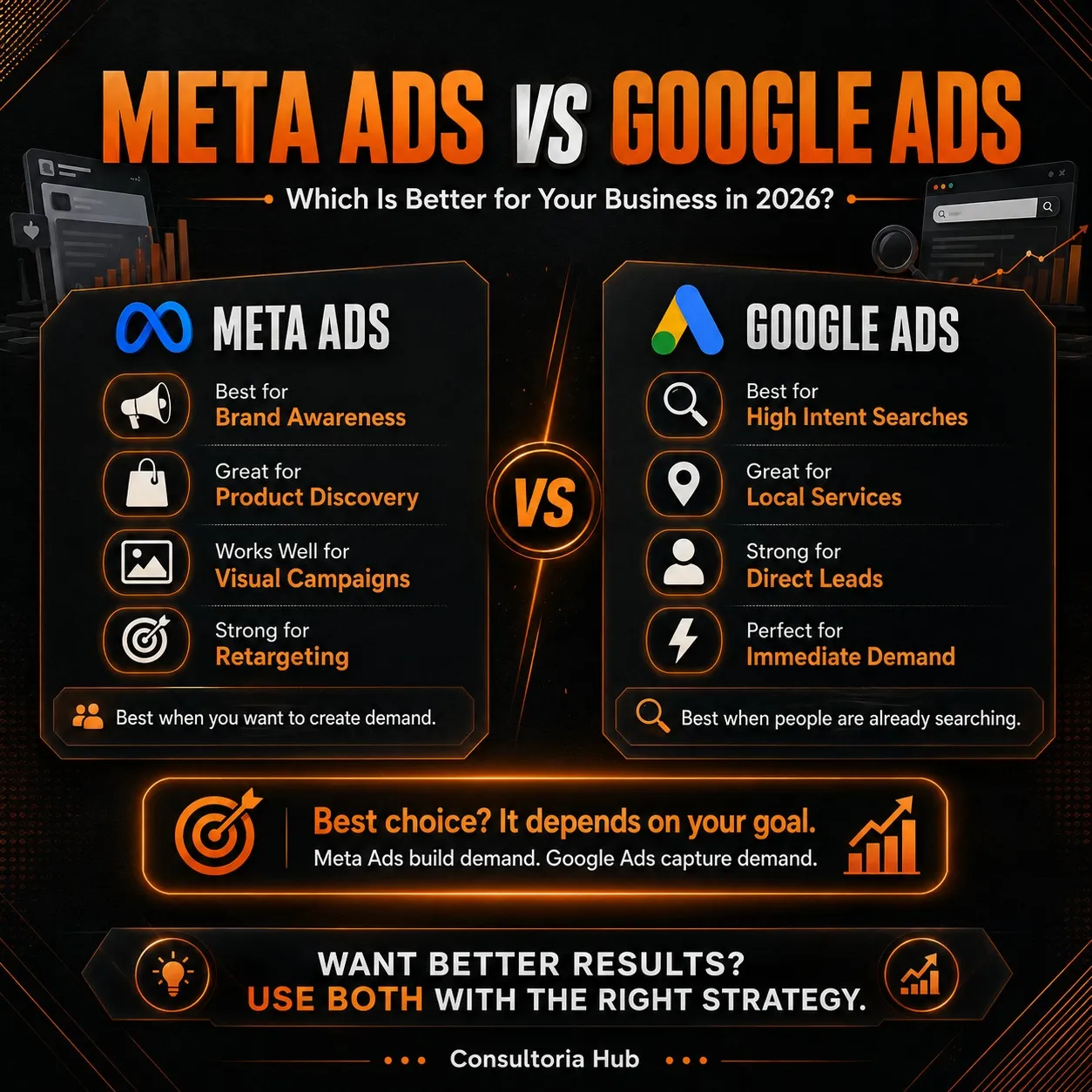
This is the single biggest difference. Google captures demand — the customer is already searching. Meta creates demand — you introduce your product to people who were not looking for it yet. A plumber with a burst pipe searches on Google. A shopper who stops scrolling to look at a new dress was reached by Meta.
Audience targeting
Google targets people based on the keywords they search. Meta targets people based on who they are — their interests, behaviour, and demographics. In 2026, both platforms have moved toward broader, AI-driven targeting, so feeding the algorithm clean data and strong creative now matters more than manual audience tweaking.
Ad formats
Google runs search text ads, shopping ads, display banners, and YouTube video ads. Meta is built around visuals — image ads, carousels, Stories, and short video across Facebook and Instagram. If your product needs to be seen and felt, Meta’s formats give you room to show it.
Cost considerations
Meta usually has a lower cost per click, while Google’s clicks are often more expensive, especially in competitive fields like legal, insurance, and finance. But cheaper clicks do not always mean cheaper customers. Because Google traffic has higher intent, it often converts at a higher rate. The metric that truly matters is cost per acquisition — what you pay to actually get a customer — not the cost of a single click.
Lead generation
For direct, high-intent leads, Google is often the stronger starting point because people are actively searching for your service. Meta, however, offers Lead Ads that let users submit their details without leaving the app, which reduces friction and can lower cost per lead — though those leads sometimes need more qualifying.
Ecommerce sales
Both platforms perform well for ecommerce. Meta shines for visual discovery and impulse purchases, while Google Shopping captures people already searching for a specific product. Many successful stores use Meta to spark interest and Google to close buyers who are ready.
Brand awareness
Meta is the clear leader for awareness and discovery. Its visual, scroll-based environment is ideal for putting your brand in front of large audiences repeatedly. Google’s YouTube ads also support awareness, but Meta remains the go-to for building recognition from scratch.
Both platforms let you re-reach people who already visited your website or engaged with your content. Meta’s retargeting is excellent for warming up an audience over several exposures. Google’s retargeting works across Search and Display and is powerful for re-capturing people who showed intent but did not convert.
Quick Comparison Table
| Factor | Meta Ads | Google Ads |
|---|---|---|
| Core approach | Creates demand (discovery) | Captures demand (intent) |
| Where ads show | Facebook, Instagram, Messenger | Search, YouTube, Gmail, Display |
| User mindset | Browsing, not searching | Actively looking to buy |
| Best formats | Video, carousel, image, Stories | Search text, Shopping, YouTube |
| Cost per click | Usually lower | Often higher, esp. competitive niches |
| Conversion intent | Lower (needs nurturing) | Higher (ready to act) |
| Best for | Awareness, ecommerce, visual brands | Leads, services, high-intent search |
Note: costs and averages vary by industry, offer, and competition. Treat these as general patterns, not guarantees.
Which Platform Is Better for Ecommerce Businesses?
For most ecommerce brands, Meta is a natural starting point. Visual, impulse-friendly products — fashion, accessories, home goods, beauty — do well in a scroll-based feed where a good photo or short video can stop someone mid-swipe.
That said, Google Shopping is powerful for capturing shoppers who already know what they want and are searching for it by name. In practice, the strongest ecommerce results usually come from using both: Meta to create interest and Google to catch the ready-to-buy searchers. If your budget is limited, start with the platform that matches your product — visual and new, lean Meta; searched-for and specific, lean Google.
Which Platform Is Better for Service Businesses?
Service businesses — consultants, clinics, repair services, law firms, agencies — often get better results from Google Ads, because their customers are actively searching for help. Someone typing “AC repair near me” or “tax consultant in Lahore” has clear intent, and Google puts you right in that moment.
Meta still has a role for service businesses, especially for building awareness, showcasing results, and retargeting people who visited but did not enquire. But if you need leads today, Google’s intent-driven traffic is usually the faster path.
When Should You Use Meta Ads?
- Your product is visual and benefits from being seen (fashion, food, beauty, home).
- You are launching something new that people are not searching for yet.
- You want to build brand awareness and a following.
- You have strong creative — good photos, videos, or Reels.
- You want to retarget and nurture an audience over time.
When Should You Use Google Ads?
- People are already searching for your product or service.
- You need leads or sales quickly from high-intent buyers.
- You run a local service business (clinic, repair, consultancy).
- You sell specific, searched-for products (Google Shopping).
- You want to capture demand at the exact moment it appears.
Should You Use Meta Ads and Google Ads Together?
For many businesses, yes — and this is where the real growth happens. The two platforms cover different stages of the customer journey. Meta warms people up and creates interest; Google captures them when they are ready to act. Used together, they form a full funnel rather than two separate experiments.
A simple example: a customer discovers your brand through an Instagram video, thinks about it for a few days, then searches your name on Google and buys. If you are only running one platform, you miss part of that journey. That said, running both well needs a healthy budget and proper tracking, so if funds are tight, it is smarter to master one platform first before expanding.
Common Mistakes Businesses Make With Paid Advertising
- Choosing a platform by habit, not by goal. Running Meta because a friend did, when Google fits your business better.
- Judging success by cost per click. The real number that matters is what it costs to get a paying customer.
- Weak or generic creative. On Meta especially, poor visuals sink even a good offer.
- No conversion tracking. Without it, the AI cannot optimise and you cannot tell what is working.
- Giving up too early. Both platforms need a learning period before results stabilise.
- Blaming the platform. Often it is the offer or the funnel that needs fixing, not the ads.
At Consultoria Hub, we work with businesses across Pakistan and beyond to build advertising that actually pays for itself. As a digital advertising agency in Karachi, we do not push one platform on everyone — we look at your goals, product, and budget, then recommend the mix that makes sense.
Our paid advertising services in Pakistan include Meta Ads and Google Ads management, along with the pieces that make ads work: landing pages, tracking, creative, and clear reporting. We also support the wider picture — social media marketing, website development, SEO, branding, and ecommerce marketing — so your advertising sits on a strong foundation rather than running in isolation.
Whether you are a startup running your first campaign or an established brand looking to scale, our goal is simple: turn ad spend into measurable growth.
Final Recommendation
There is no universal winner in the Meta Ads vs Google Ads question. If people are already searching for what you offer, start with Google. If you need to build interest and show off a visual product, start with Meta. And once you have budget and clean tracking, running both together often delivers the strongest, most sustainable results.
The platform matters, but execution matters more. A well-run campaign on the right platform, backed by a solid offer and proper tracking, is what turns advertising into a growth engine.
Frequently Asked Questions
Is Meta Ads or Google Ads better for a small business in Pakistan?
It depends on your goal. If customers already search for your product or service, Google Ads usually delivers faster leads. If you sell a visual product or need to build awareness, Meta Ads is often the better start. Many small businesses begin with one and add the other as they grow.
Which platform is cheaper, Meta Ads or Google Ads?
Meta Ads generally have a lower cost per click, while Google Ads clicks tend to cost more, especially in competitive fields. But cheaper clicks do not always mean cheaper customers — Google traffic often converts at a higher rate. Compare cost per customer, not cost per click.
Can I run both Meta Ads and Google Ads at the same time?
Yes, and for many businesses it works best. Meta creates interest and Google captures ready buyers, so together they cover the full customer journey. Just make sure you have enough budget and proper tracking to run both effectively.
Which platform is best for ecommerce?
Both work well. Meta is strong for visual discovery and impulse buys, while Google Shopping captures people searching for specific products. Most successful stores use both, but if budget is tight, match the platform to your product type.
How much budget do I need to start with paid ads?
There is no fixed minimum, but a realistic budget lets the platform’s AI learn and optimise. Rather than a specific figure, focus on giving a single platform enough runway to gather data before judging results. We help clients set a budget that fits their goals.
Ready to make your ad budget work harder?
Let’s talk about your goals and build a Meta Ads or Google Ads strategy that fits your business.
Reach out to Consultoria Hub for a straightforward conversation about growing your leads and
sales in 2026.
Contact Consultoria Hub — Your digital advertising partner in Karachi.